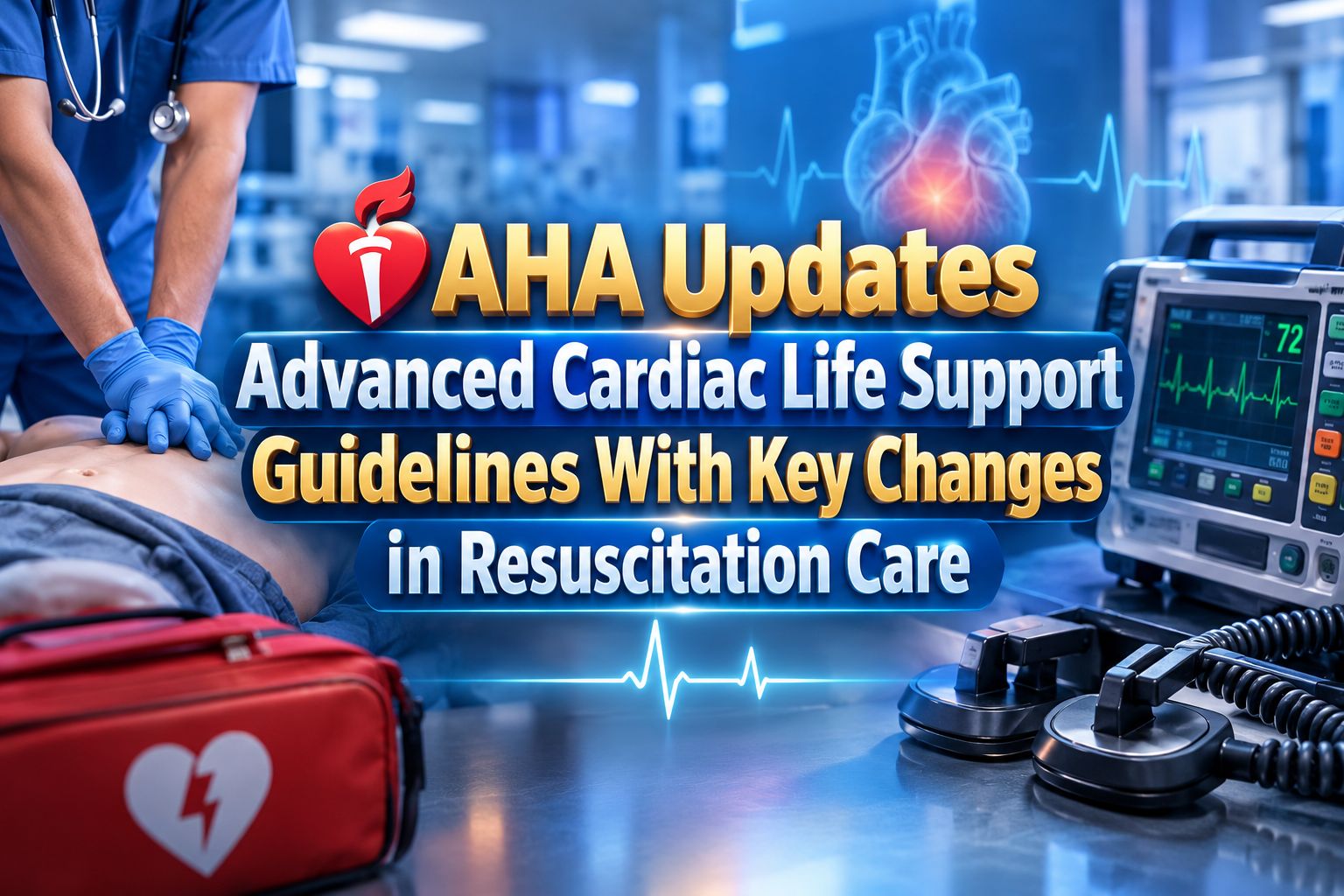
USA: The American Heart Association (AHA) has updated its 2025 Adult Advanced Life Support (ALS) guidelines, introducing important recommendations for managing cardiac arrest and other life-threatening cardiovascular emergencies.
The updated guidance focuses on refining established resuscitation practices, including CPR, defibrillation, cardioversion, vascular access, airway management, point-of-care ultrasound and post-cardiac arrest care.
Key Changes in the Updated Guidelines
CPR Should Not Be Delayed in Opioid Overdose
The AHA emphasizes that CPR should begin immediately when cardiac arrest occurs following a suspected opioid overdose. Naloxone may be administered when appropriate, but CPR should not be delayed while waiting for its effect.
Manual CPR Remains Preferred
Manual chest compressions remain the standard approach for adult cardiac arrest. Mechanical CPR devices are not recommended for routine use but may be considered in situations where effective manual CPR is difficult.
Vascular Access
Intravenous (IV) access remains the preferred route for administering medications during resuscitation. If IV access cannot be established quickly, intraosseous (IO) access can be used.
Higher Energy for Atrial Fibrillation and Flutter
For patients requiring electrical cardioversion for atrial fibrillation or atrial flutter, the updated guidance recommends an initial biphasic energy of at least 200 joules.
Refractory Ventricular Fibrillation
The effectiveness of vector-change defibrillation and double sequential defibrillation for persistent shock-refractory ventricular fibrillation remains uncertain. The AHA states that more research is needed before their routine use can be recommended.
Immediate Treatment for Polymorphic VT
Polymorphic ventricular tachycardia is considered an unstable rhythm and requires immediate defibrillation. Rapid treatment is essential to prevent deterioration.
Point-of-Care Ultrasound
Experienced clinicians may use point-of-care ultrasound (POCUS) during cardiac arrest to identify potentially reversible causes. However, ultrasound must not cause unnecessary interruptions to chest compressions.
Post-Cardiac Arrest Care
The updated guidance also addresses temperature management following return of spontaneous circulation (ROSC). Targeted temperature management may be used to maintain approximately 36°C for at least 36 hours, according to the updated recommendations.
Expanding CPR Education
The AHA highlights the importance of wider CPR and AED training. Children as young as 12 years can be trained to perform CPR and use an automated external defibrillator, potentially improving community preparedness for cardiac emergencies.
Cognitive Aids During Resuscitation
Healthcare professionals may use checklists, algorithms and digital applications as cognitive aids during resuscitation. However, for lay rescuers, starting CPR quickly remains the priority.
Conclusion
The updated AHA Adult Advanced Life Support guidelines maintain the core principles of ACLS while refining recommendations for several important clinical situations.
The changes reinforce the importance of rapid recognition, high-quality CPR, timely defibrillation, appropriate medication access, careful use of advanced technologies and structured post-cardiac arrest care.
Overall, the updated recommendations aim to support evidence-based resuscitation and improve outcomes for patients experiencing life-threatening cardiovascular emergencies.