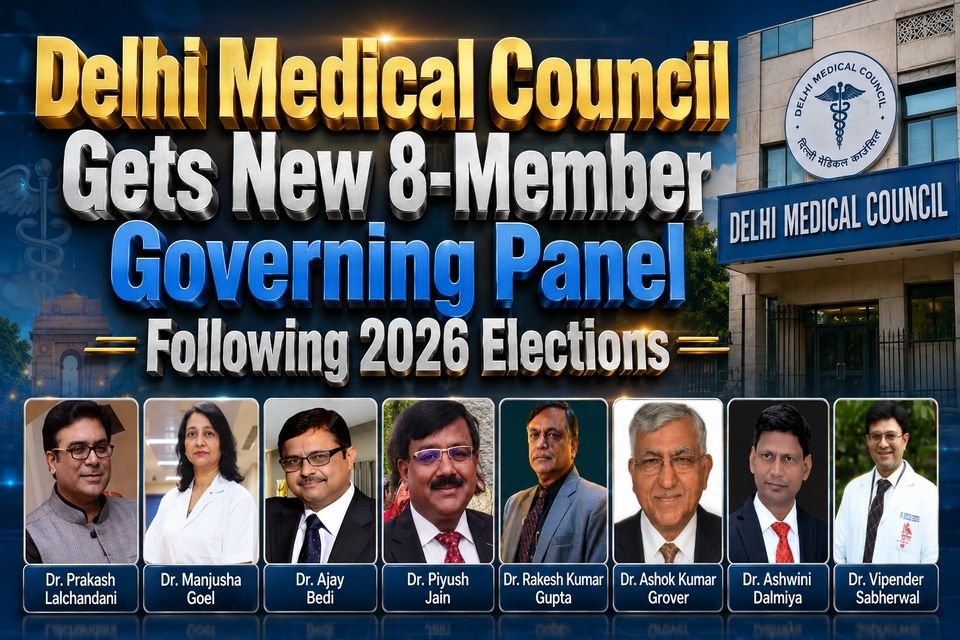
New Delhi: The Delhi Medical Council (DMC), the statutory body responsible for regulating the practice of modern medicine in the national capital, has elected a new eight-member governing panel following the successful completion of the 2026 council elections. The results were declared on May 31, 2026, after a day-long polling process that witnessed active participation from registered medical practitioners across Delhi.
The elections were conducted at the Delhi Medical Council office in Shastri Park, New Delhi, with voting taking place between 9:00 AM and 5:00 PM. A total of 38 candidates contested for positions in the governing body, reflecting strong interest from the medical fraternity in shaping the future of the council.
Dr. Prakash Lalchandani Emerges as Highest Vote-Getter
Among the elected members, Dr. Prakash Lalchandani secured the highest number of votes, receiving 2,481 votes. He was followed closely by Dr. Manjusha Goel, who garnered 2,388 votes, and Dr. Ajay Bedi, who received 2,312 votes.
The newly elected eight-member panel includes:
Dr. Prakash Lalchandani – 2,481 votes
Dr. Manjusha Goel – 2,388 votes
Dr. Ajay Bedi – 2,312 votes
Dr. Piyush Jain – 2,267 votes
Dr. Rakesh Kumar Gupta – 2,206 votes
Dr. Ashok Kumar Grover – 2,176 votes
Dr. Ashwini Dalmiya – 2,133 votes
Dr. Vipender Sabherwal – 2,017 votes
The elected members will now play a crucial role in steering the council's regulatory and administrative responsibilities over the coming years.
Significance of the Election
The 2026 elections carry particular importance as they mark a significant milestone in the reconstitution of the Delhi Medical Council following a turbulent period marked by governance concerns and administrative challenges.
In 2025, the Delhi Government dissolved the existing council amid allegations of irregularities and mismanagement. During the interim period, the Directorate General of Health Services (DGHS) was entrusted with handling essential council functions, including medical registrations and regulatory responsibilities.
The election of a new governing body is therefore being viewed as an important step toward restoring institutional stability, strengthening professional oversight, and rebuilding confidence among healthcare professionals.
Expectations from the New Governing Body
As the regulatory authority overseeing medical practitioners in Delhi, the newly elected panel is expected to address several key priorities, including:
Enhancing transparency in council operations
Strengthening ethical and professional standards in medical practice
Improving efficiency in medical registration and licensing processes
Addressing grievances and concerns of healthcare professionals
Ensuring accountability in regulatory decision-making
Modernizing administrative systems and governance mechanisms
Healthcare stakeholders and members of the medical community are hopeful that the new leadership will usher in reforms that promote trust, integrity, and efficiency within the council.
Legal Scrutiny Continues
While the election process concluded successfully, it has not been entirely free from controversy. Reports indicate that legal challenges were raised regarding certain aspects of the election process, including allegations related to conflicts of interest and procedural irregularities.
The matter has reportedly been brought before the Delhi High Court, which has sought responses from the concerned parties. Further proceedings are expected in the coming months.
Looking Ahead
The formation of the new Delhi Medical Council governing panel represents a fresh chapter for one of India's most important medical regulatory bodies. With growing expectations from both doctors and healthcare institutions, the council's new leadership will be tasked with strengthening governance standards while ensuring that the interests of patients and medical professionals remain at the forefront of its mission.
As Delhi's healthcare ecosystem continues to evolve, the decisions and reforms implemented by the newly elected panel are expected to play a critical role in shaping the future of medical regulation and professional accountability in the capital.