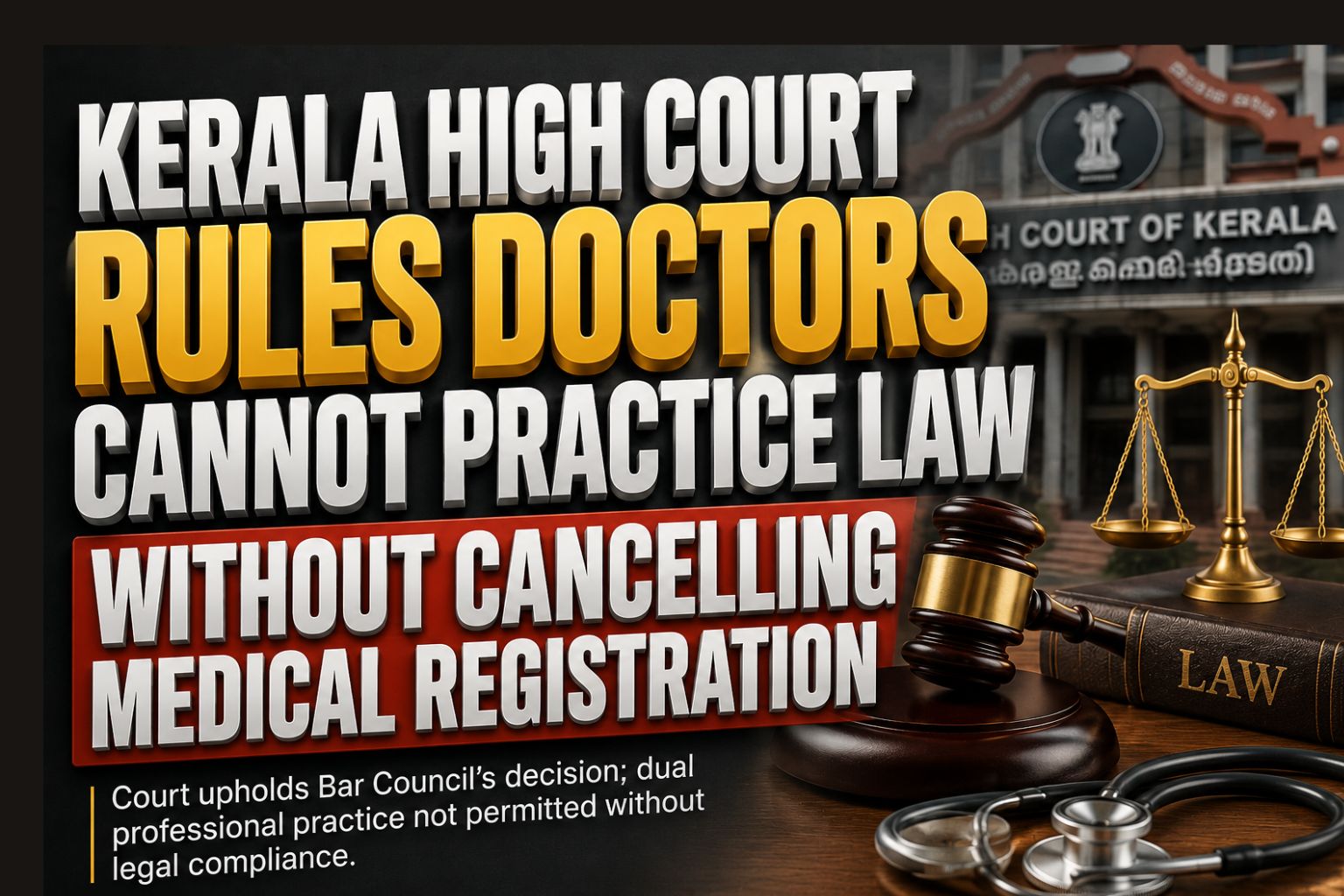
In a significant judgment concerning professional ethics and dual careers, the Kerala High Court has ruled that registered doctors cannot pursue another profession, including legal practice, without first cancelling their medical registration. The ruling came while dismissing a plea filed by a homeopathic doctor seeking permission to enroll as an advocate while retaining her medical registration.
The verdict has sparked discussion across medical and legal circles regarding professional accountability, ethical obligations, and the limits of dual professional practice in India.
Background of the Case
The case involved a homeopathic doctor who had completed her law degree and successfully cleared the All India Bar Examination. She later approached the Bar Council of Kerala for enrollment as an advocate.
However, the Bar Council asked her to produce proof showing cancellation of her registration as a medical practitioner before proceeding with her enrollment application.
The petitioner argued that she had already stopped practicing medicine, closed her clinic, and cancelled the municipal license associated with it. She also submitted an undertaking stating that she would not continue medical practice after becoming an advocate.
Despite these submissions, the Bar Council maintained that her name still existed in the official register of medical practitioners, meaning she legally retained the right to practice medicine.
Bar Council Opposed Dual Professional Practice
According to the Bar Council of Kerala, rules governing enrollment of advocates prohibit individuals from simultaneously engaging in another profession, business, or trade.
The Council argued that:
The petitioner continued to hold valid medical registration,
she had not formally surrendered her registration certificate,
allowing simultaneous professional eligibility could violate professional ethics and existing legal rules.
The Bar Council further stated that similar requirements are imposed on all professionals seeking enrollment as advocates, ensuring uniformity in legal practice standards.
Kerala High Court’s Observations
Justice Bechu Kurian Thomas, while hearing the matter, made several strong observations regarding the nature of professional dedication and ethical responsibility.
The Court observed that merely stopping active medical practice is not enough if the individual continues to remain registered as a doctor. According to the judgment, retaining medical registration means the person still possesses the legal authority to practice medicine.
The Court famously remarked that:
“Splitting the professional soul between two masters can lead to losing focus in both professions.”
The judgment also described the legal profession as a “jealous mistress,” emphasizing that advocacy requires complete commitment and undivided professional loyalty.
Legal Provisions Examined
The Court examined provisions under:
the Advocates Act, 1961,
Bar Council of Kerala Rules, 1979,
Travancore-Cochin Medical Practitioners Act, 2021.
A key point discussed was Section 31(2) of the Medical Practitioners Act, which states that registered medical practitioners cannot pursue another profession without permission while their names remain on the medical register.
The Court also referred to Bar Council rules requiring applicants to declare that they are not engaged in any other profession except certain permitted academic activities.
Supreme Court Judgment Referenced
The Kerala High Court relied on the landmark Supreme Court decision in Dr Haniraj L. Chulani vs Bar Council of Maharashtra & Goa.
In that judgment, the Supreme Court had similarly held that practicing both medicine and law simultaneously could create conflicting duties and ethical concerns.
The Court reiterated that both professions demand full-time dedication due to their direct impact on public welfare and justice.
Final Verdict
The Kerala High Court ultimately dismissed the petition and upheld the Bar Council’s decision.
The Court ruled that:
doctors must cancel their medical registration before entering legal practice,
merely shutting down a clinic is insufficient,
continued registration indicates ongoing professional entitlement,
Bar Councils are legally empowered to deny enrollment in such situations.
The ruling is expected to become an important reference point for future cases involving dual professional practice in India.
For medical and legal professionals alike, the judgment reinforces the principle that certain professions require complete commitment and cannot be pursued simultaneously without regulatory compliance.