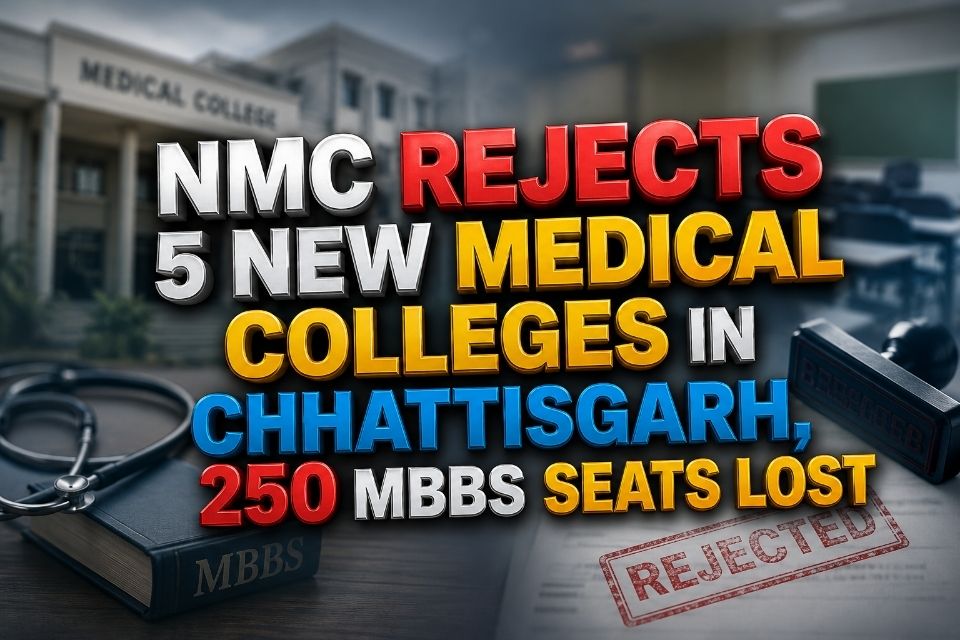
Raipur, Chhattisgarh: In a significant setback to medical education expansion in Chhattisgarh, the National Medical Commission (NMC) has rejected applications for the establishment of five new government medical colleges across the state. The decision is expected to result in the loss of 250 MBBS seats that were proposed for the 2026-27 academic session.
The rejected proposals were for medical colleges planned in the districts of Kawardha, Janjgir-Champa, Manendragarh, Dantewada, and Kunkuri. Each institution was expected to admit 50 MBBS students annually, contributing substantially to the state's healthcare education infrastructure.
Reasons Behind the Rejection
According to reports, NMC inspection teams identified multiple deficiencies during the assessment process. The proposed institutions reportedly failed to meet several mandatory requirements laid down by the regulatory body.
Key shortcomings highlighted by the NMC include inadequate infrastructure, incomplete laboratory facilities, shortage of qualified faculty members, insufficient medical equipment, and non-compliance with documentation requirements. In some cases, the colleges also failed to submit affiliation certificates from the concerned Health Sciences University, a mandatory prerequisite for approval.
The inspection findings suggest that while administrative processes had been initiated, several institutions were not fully prepared for regulatory evaluation. Infrastructure development, faculty recruitment, and operational readiness were found to be below the standards required for establishing new medical colleges.
Impact on Medical Aspirants
The rejection comes at a time when demand for MBBS seats continues to rise across the country. With the loss of 250 potential seats, aspiring medical students in Chhattisgarh may face increased competition during the admission process.
Education experts believe the additional seats would have provided greater opportunities for NEET-qualified candidates while also helping address the shortage of medical professionals in the region. The decision may particularly affect students from remote and underserved districts where the proposed colleges were expected to improve access to medical education.
Setback to Healthcare Expansion Plans
The five proposed institutions were part of the state's broader strategy to strengthen healthcare infrastructure and expand medical education facilities. New medical colleges not only increase educational opportunities but also contribute to improved healthcare services through associated teaching hospitals and medical facilities.
Had the colleges received approval, Chhattisgarh's total MBBS seat capacity would have increased significantly, helping the state meet the growing demand for medical education and healthcare professionals.
State Government Plans to Appeal
Following the rejection, the Chhattisgarh government has reportedly acknowledged the deficiencies pointed out by the NMC and is preparing corrective measures. Officials have indicated that efforts will be made to address infrastructure gaps, complete faculty recruitment, and ensure compliance with all regulatory requirements.
The state government is also expected to file an appeal against the NMC's decision while simultaneously working to strengthen the readiness of the proposed institutions for future inspections.
Looking Ahead
The NMC's decision serves as a reminder of the stringent standards required for establishing medical colleges in India. While the rejection delays the expansion of medical education in Chhattisgarh, authorities remain hopeful that the identified deficiencies can be rectified and the projects revived in the coming years.
For now, the loss of 250 MBBS seats represents a considerable setback for both aspiring medical students and the state's efforts to expand its healthcare education network.