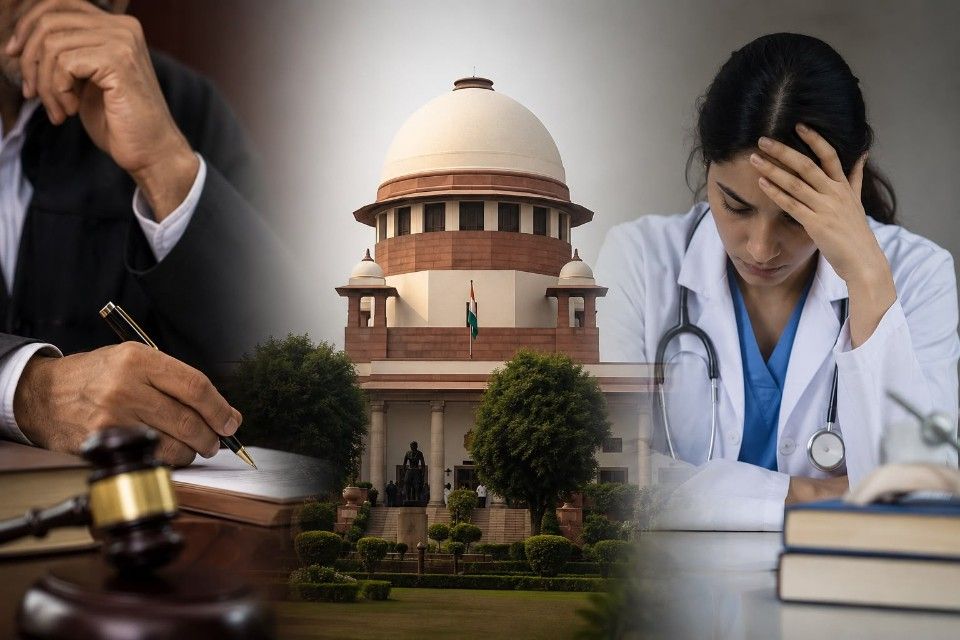

New Delhi: The National Medical Commission (NMC) has informed the Supreme Court that prolonged and multiple 24-hour duty shifts are among the leading causes of mental health problems faced by postgraduate (PG) medical students in India. In an affidavit filed before the apex court, the Commission acknowledged that excessive duty hours not only affect the physical and psychological well-being of resident doctors but may also compromise patient safety.
The submission was made in response to a Public Interest Litigation (PIL) seeking implementation of the 1992 Uniform Residency Scheme, which prescribes regulated working hours for resident doctors across the country.
Long and Consecutive 24-Hour Duties Raise Serious Concerns
Referring to the findings of the National Task Force (NTF) 2024, the NMC stated that demanding work schedules, including long and multiple 24-hour duties, are significant contributors to stress among postgraduate medical students. According to the report, some residents are required to perform three to five consecutive 24-hour duties, leaving little time for adequate rest or recovery.
The Commission noted that such prolonged duty hours often result in:
Physical exhaustion
Mental fatigue
Sleep deprivation
Decline in overall health
Reduced work performance
Increased risk to patient safety
1992 Residency Scheme Remains Largely Unimplemented
The NMC reminded the Supreme Court that the Uniform Residency Scheme of 1992 was introduced to prevent excessive workloads among resident doctors. The scheme recommended that residents should generally not exceed 12 hours of continuous active duty per day and 48 hours of work per week.
However, according to the Commission, these recommendations could not be effectively implemented due to shortages of healthcare personnel and other logistical challenges faced by medical institutions.
National Task Force Recommends Practical Duty-Hour Reforms
Recognizing the realities of healthcare delivery, the National Task Force proposed a more practical framework aimed at protecting both resident doctors and patients. The recommendations include:
Maximum 74 working hours per week
No more than 24 continuous hours of duty
One weekly day off
One scheduled 24-hour duty per week
Five 10-hour working shifts
At least 7–8 hours of sleep every day to maintain physical and mental well-being.
Flexible Duty Rosters Suggested
To improve working conditions, the Task Force recommended that Heads of Departments (HODs), faculty members, senior residents and junior residents jointly prepare duty rosters based on available manpower.
Hospitals may adopt:
Three-shift systems
Two-shift systems
Single-shift models where necessary
The report also emphasized strict adherence to the NMC regulation providing one mandatory day off every week for resident doctors.
Medical Training Should Remain the Primary Focus
The NMC further emphasized that postgraduate students and interns are primarily trainees pursuing medical education rather than serving solely as the workforce of hospitals. It highlighted the need to balance clinical responsibilities with academic learning while ensuring safe working conditions and adequate rest.
PIL Highlights Resident Doctors' Working Conditions
The matter reached the Supreme Court through a Public Interest Litigation filed by the United Doctors' Front (UDF), which challenged what it described as exploitative and unconstitutional working conditions imposed on resident doctors.
The petition seeks enforcement of the 1992 Residency Scheme and argues that many medical institutions continue to require residents to work far beyond the prescribed duty-hour limits despite earlier directives.
Mental Health Crisis Among Medical Students
The PIL also referred to findings of the National Task Force on the mental health and well-being of medical students, which documented more than 150 suicides among medical students over a five-year period. Work-related stress, prolonged duty hours and sleep deprivation were identified as major contributing factors behind the growing mental health crisis.
NMC Clarifies Role in Implementation
While informing the Supreme Court that it has already taken steps to regulate duty hours and improve the mental well-being of medical students and resident doctors, the NMC clarified that the implementation of working-hour regulations primarily lies with state governments and individual medical institutions. The
Commission stated that its statutory role under the National Medical Commission Act, 2019, is to regulate medical education and academic standards rather than manage hospital staffing or duty rosters.
Conclusion
The NMC's submission before the Supreme Court has once again drawn attention to the demanding working conditions faced by resident doctors in India. As concerns over burnout, sleep deprivation and mental health continue to grow, the recommendations of the National Task Force—including regulated duty hours, adequate rest and structured work schedules—could play a significant role in improving the well-being of postgraduate medical students while strengthening patient safety across healthcare institutions.