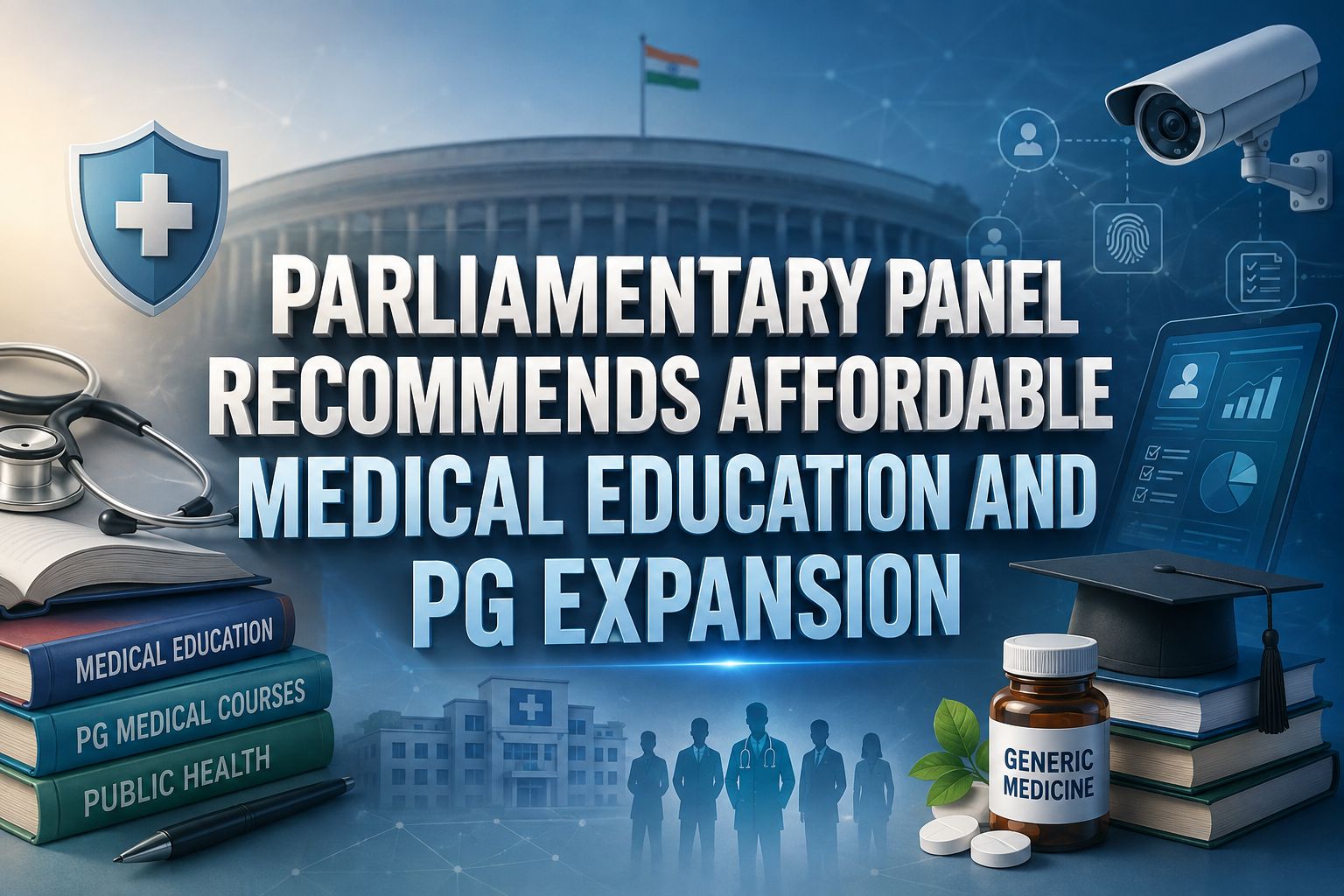
New Delhi: A Parliamentary Standing Committee on Health and Family Welfare has made several important recommendations aimed at improving the affordability, accessibility, quality and transparency of medical education in India.
The recommendations focus on striacter regulation of medical college fees, expansion of postgraduate medical education, technology-based monitoring of institutions, stronger public health training and the promotion of affordable generic medicines.
Focus on Affordable Medical Education
One of the Committee's major concerns is the rising cost of medical education, particularly in private medical colleges and deemed universities.
It recommended strict enforcement of regulations governing fees and other charges for 50% of seats in private medical colleges and deemed universities.
The Committee warned that excessive fees, hidden charges and capitation fees could make medical education inaccessible to students from economically weaker sections. It also recommended stronger financial monitoring and audits of institutional cost structures to improve transparency.
The overall objective is to ensure that medical education remains affordable and does not become excessively commercialised.
Push for Expansion of PG Medical Education
The Committee also recommended greater flexibility in expanding postgraduate medical education to address India's growing need for specialist doctors.
The report highlighted changes under the Minimum Standard Requirements (MSR) 2023, including reduced infrastructure requirements for medical colleges.
A 100-seat medical college requires 420 beds, compared with the earlier requirement of 500 beds, while a 250-seat institution requires 900 beds, compared with the previous requirement of 1,100 beds.
However, institutions must maintain an 80% bed occupancy rate to ensure adequate clinical exposure for students.The Committee stressed that increasing PG seats should not compromise the quality of clinical training.
Earlier Introduction of PG Courses
The panel recommended allowing government medical institutions to introduce postgraduate programmes alongside undergraduate courses, provided adequate clinical facilities and patient exposure are available.
For private medical colleges, it recommended allowing PG specialities to be introduced from the third operational year, subject to proper clinical training facilities.
The proposed model could also simplify faculty requirements for individual specialities, with one Professor and one Associate Professor or Assistant Professor, depending on regulatory requirements and clinical exposure.
Using More Hospitals for PG Training
To increase PG training opportunities in underserved regions, the Committee suggested exploring specialised public healthcare facilities, including Railways and Mines hospitals.
Such institutions could help expand specialist medical training, particularly in tribal, hilly and underserved areas where PG opportunities remain limited.
The Committee also recommended introducing an Exit Examination for both undergraduate and postgraduate medical students to maintain consistent standards of competency.
Digital Monitoring of Medical Colleges
A major part of the Committee's recommendations focuses on replacing traditional periodic inspections with more continuous and technology-driven monitoring.
The proposed system includes:
Annual self-declarations through a centralised portal
Standardised virtual inspections
Digital reporting during physical assessments
IT-enabled uploading of assessment reports
The Committee believes digital monitoring could reduce subjectivity and improve transparency in institutional assessments.
Biometric Attendance and Face Authentication
The Committee recommended strengthening the Aadhaar-enabled biometric attendance system (AEBAS) across medical institutions.
The digital system monitors faculty members, students, interns and tutors, with more than 4 lakh individuals reportedly covered under the framework.
It also recommended wider implementation of face-authentication technology through geo-fenced applications to prevent the practice of maintaining “ghost faculty” on institutional records.
Monitoring Clinical Data Through Technology
The panel recommended expanding Hospital Management Information System integration with unique ABHA IDs.
This could allow authorities to digitally verify clinical material and patient data used during institutional assessments and reduce the possibility of manipulated patient records or clinical workload data.
The recommendations also include CCTV monitoring in classrooms and hospital areas to improve transparency and prevent irregularities during inspections.
Greater Focus on Public Health Training
The Committee recommended stronger coordination between different boards under the National Medical Commission to ensure medical education remains aligned with India's public health priorities.
It also called for continued improvements to the Competency-Based Medical Education (CBME) curriculum, with greater emphasis on:
Primary healthcare
Preventive healthcare
Practical clinical skills
Community-based training
The Committee further recommended stronger implementation of Village and Family Adoption Programmes, helping medical students gain better exposure to rural healthcare challenges.
Push for Affordable Generic Medicines
The Parliamentary Committee also raised concerns about the high cost of medicines and their impact on patients' out-of-pocket healthcare expenditure.
It recommended stronger enforcement of professional conduct rules encouraging doctors to prescribe affordable generic medicines where appropriate.
The panel also suggested improved monitoring of prescription practices through:
Integration of relevant healthcare and procurement data
Automated grievance mechanisms through State Medical Councils
Auditing prescription patterns in public and private hospitals
These measures could help identify prescribing practices that unnecessarily increase the financial burden on patients.
Conclusion
The Parliamentary Committee's recommendations focus on creating a medical education system that is more affordable, transparent, accessible and technology-driven.
The key proposals include stricter fee regulation, faster expansion of PG education, digital monitoring of medical institutions, improved public health training and greater promotion of affordable medicines.
While these recommendations could significantly influence the future of medical education and healthcare regulation in India, they are currently recommendations and not automatically implemented regulations.
Their implementation will depend on future action by the National Medical Commission, the Ministry of
Health and Family Welfare and other concerned authorities.