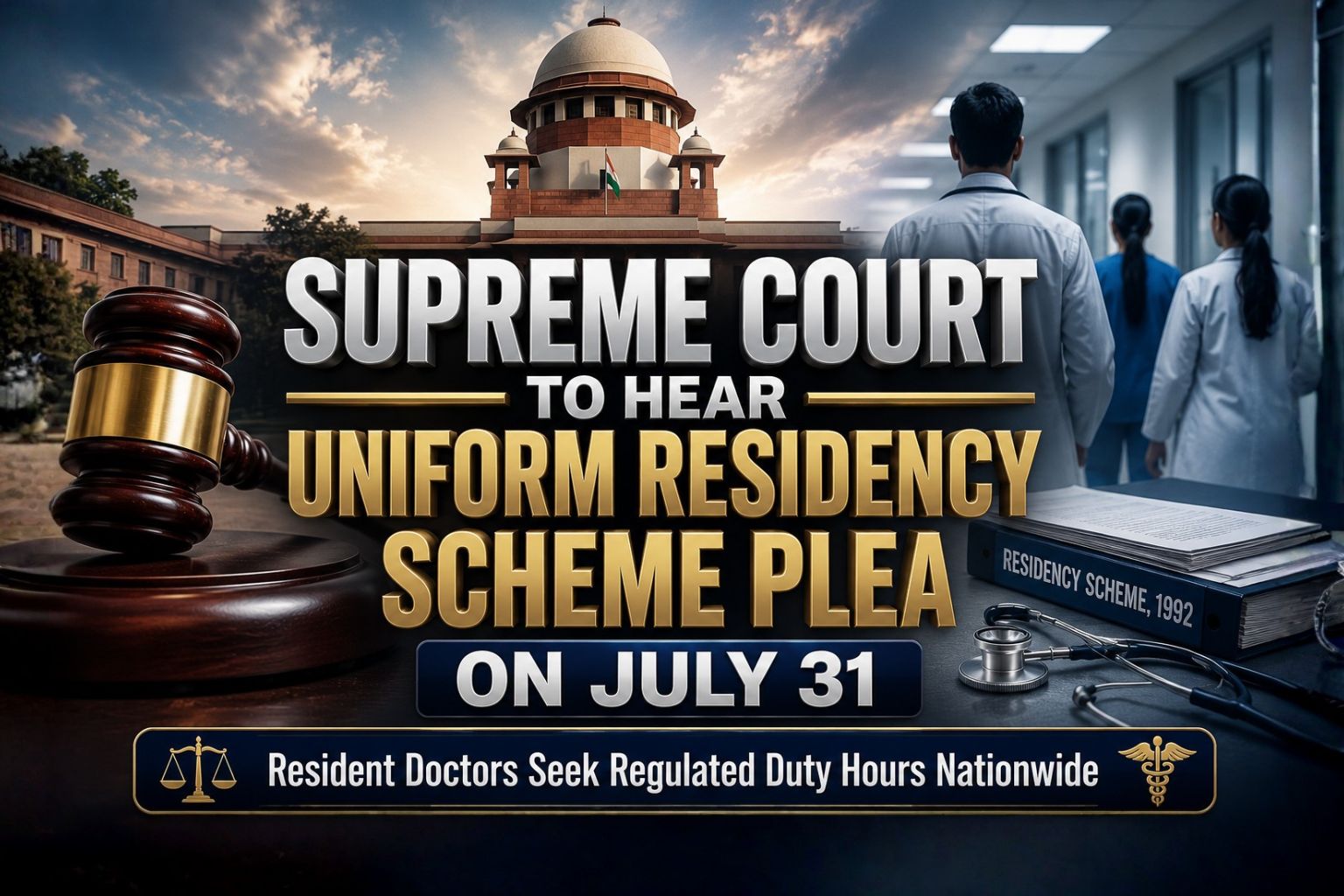
New Delhi: The Supreme Court is expected to hear a Public Interest Litigation (PIL) on July 31, 2026, seeking the implementation of a Uniform Residency Scheme (URS) across all medical colleges in India. The plea aims to establish standardized duty hours and improve the working conditions of resident doctors, a long-standing concern within the country's healthcare system.
The petition, filed by the United Doctors Front (UDF), calls for the uniform enforcement of the Residency Scheme, 1992, which outlines duty-hour regulations for resident doctors. According to the petitioners, although these guidelines already exist, their implementation remains inconsistent across government and private medical institutions, resulting in excessive workloads and prolonged working hours for resident doctors.
Demand for Standardized Duty Hours
The plea seeks the introduction of uniform duty-hour regulations applicable to all resident doctors in India. Among the key demands are:
A maximum of 12 working hours per shift.
A limit of 48 working hours per week.
At least one mandatory weekly off for every resident doctor.
Effective monitoring and enforcement of these standards by the concerned authorities.
The petition argues that implementing these measures would help create a safer and healthier working environment while ensuring consistency in residency training across medical institutions.
Concerns Over Long Working Hours
According to the petition, resident doctors in many hospitals continue to work extended shifts that often exceed the limits prescribed under the Residency Scheme. The petitioners contend that such demanding schedules can lead to physical exhaustion, mental stress, burnout, and reduced overall well-being among young medical professionals.
The plea further highlights that prolonged duty hours may adversely affect patient care by increasing the risk of fatigue-related medical errors. It argues that ensuring reasonable working hours is not only essential for doctors' welfare but also for maintaining high standards of patient safety.
Constitutional and Legal Perspective
The petition also raises constitutional concerns, stating that forcing resident doctors to work excessive hours without adequate rest may violate their fundamental rights under Article 21 of the Constitution, which guarantees the right to life and personal dignity.
The petitioners have requested the Supreme Court to direct authorities to ensure uniform implementation of the Residency Scheme throughout the country, irrespective of whether the institution is government-run or privately managed.
Background of the Residency Scheme
The Residency Scheme, 1992, issued by the Ministry of Health and Family Welfare, provides a framework for residency training, including guidelines related to duty hours and working conditions. However, the petition claims that the scheme has not been implemented uniformly, leading to significant variations in work schedules across different medical colleges and hospitals.
Earlier Proceedings
The issue of resident doctors' working conditions has previously come before the Supreme Court. During earlier hearings, the Court sought responses from the Union Government and the National Medical Commission (NMC) regarding the concerns raised over excessive duty hours and the implementation of residency guidelines.
The matter is now expected to be taken up again on July 31, 2026, where the Court may consider further directions on the implementation of a nationwide Uniform Residency Scheme.
Why This Hearing Matters
The upcoming hearing could have far-reaching implications for medical education and healthcare delivery across India. If the Supreme Court issues directions in favour of the petition, it could lead to:
Uniform implementation of residency regulations across all medical colleges.
Standardized duty-hour limits for resident doctors nationwide.
Improved work-life balance and mental well-being of medical residents.
Reduction in burnout and fatigue-related medical errors.
Better compliance with existing residency guidelines.
Enhanced patient safety through healthier working conditions for healthcare professionals.
The medical fraternity will closely watch the July 31 hearing, as its outcome could influence future policies governing residency training and workplace standards for thousands of resident doctors across the country.