


Doctors devote their lives to healing and rehab, but medicine is not precisely science. Even with great efforts, results can sometimes go wrong. This poses a momentous lawful question: Should every medical omission be regarded as criminal carelessness?
In India, the response lies in Section 304A of the Indian Penal Code (IPC), which deals with death spawned by reckless or careless actions. Recently, the High Court elucidated its implementation to doctors, highlighting that criminal liability springs only in cases of complete carelessness, not ordinary omissions.
📜 IPC 304A Explained
Section 304A IPC says that if someone causes death by a reckless or careless act, they may suffer criminal punishment.
But in medical cases, the law distinguishes between two types of negligence:
Civil Negligence – Where a patient can seek compensation for harm.
Criminal Negligence – Where the act is so rash and negligent that it amounts to a crime.
👉 Example: An erroneous judgment in treatment is civil negligence, but carrying out surgery under intoxication is criminal negligence.
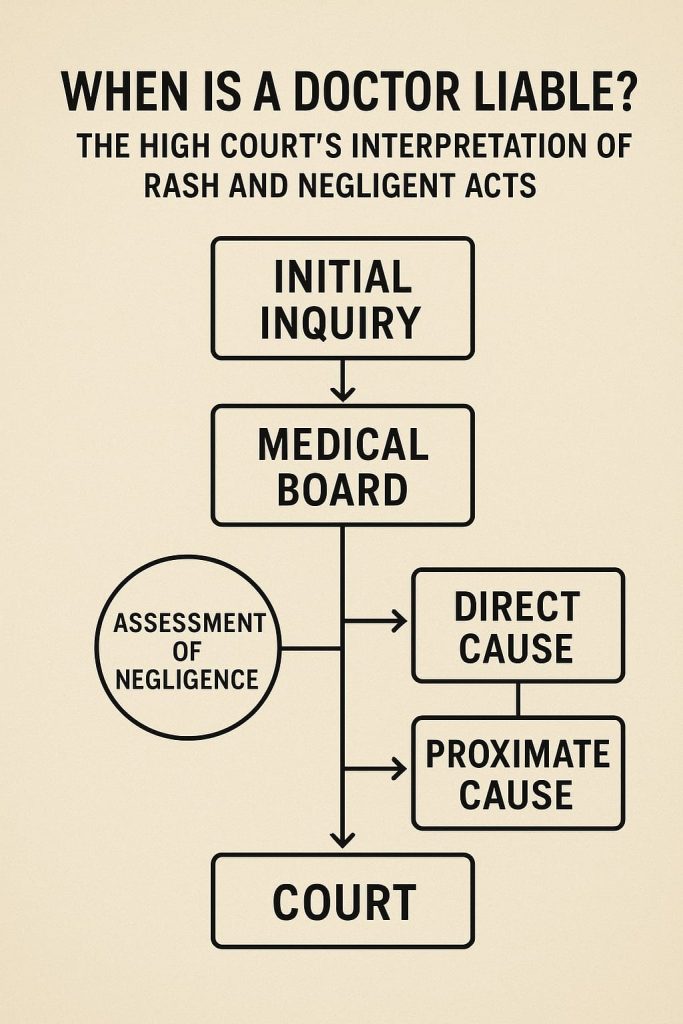
👩⚖️ High Court’s Key Observations
The High Court has emphasized certain principles to protect both patients and doctors:
1. Not Every Error is a Crime
A failed treatment or wrong diagnosis alone cannot invite criminal prosecution.
2. Gross Negligence is Required
The act must be far below the standards of a reasonably skilled doctor
3. Judicial Caution
Courts should carefully assess medical expert opinions before allowing prosecution.
4. Balance of Justice
Doctors must not be harassed by frivolous cases, but genuine reckless acts will not be excused.
📚 Judicial Precedents
This explication constructs on earlier ground-breaking rulings:
Jacob Mathew v. State of Punjab (2005) – The honourable Supreme Court held that doctors are criminally accountable only for sheer negligence, not mere mistakes.
Dr. Suresh Gupta Case (2004) – Criminal execution applies only when there is “careless slight for human life.”
The High Court has reasserted these principles, fortifying protections for doctors.
🌍 Why This Matters
🔹 For Doctors
✅Turns down fear of false complaints.
✅Cheers confident decision-making in contingencies.
✅Allows shift on patient care instead of legal harassment.
🔹 For Patients
✅Ensures accountability when negligence is truly reckless.
✅Reinforces trust that law protects their rights without discouraging doctors.
✨ Conclusion
The High Court’s observance of hasty and careless acts under IPC 304A ensures a balanced approach:
>Doctors are not criminals for every failed treatment.
>Only acts highlighting rashness or extreme careless invite criminal liability.
>This stability safeguards the integrity and probity of the medical profession while protecting patients’ rights.
In the end, medicine requires both prowess and responsibility, and law must walk together with healthcare to safeguard life with fairness.